Sexual Memoir
a year-long virtual circle for highly sensitive, spiritually attuned women seeking inner peace, pursuing joyful embodiment, & wanting to make friends

"The injured & self-injured have a right to be raised up, to be touched in a special way with love & with holiness, for these character traits are the typifiers of the word "human" found at the center of the word humane"
Clarissa Pinkola Estés Réyes
Experience vulnerability without being seen as a victim

This is for you if:
You hate thinking of yourself as a "survivor".
You struggle with dissociation, despite understanding it.
You blame yourself for your emotional pain & you are critical & judgmental of yourself for "not getting over it".
You have exhausted talk therapy.
Personal growth is a lifestyle, not a response to crisis.
You are "spiritual but not religious" & seeking support for authentically connecting with & expressing your spirituality through your body, movement, creativity, nature & more.
You regard the earth as your mother, & your body as the earth... but you struggle to mother yourself.
You crave community with open-hearted, likeminded women.
We are not meant to carry it alone.

I have met so many of you who walk with identities deeply informed by taboo experiences, constantly scanning every room & relationship, deciding what parts of yourself feel safe enough to show & what must stay hidden.
This constant vigilance & self-censorship is exhausting. Life experiences that are deeply familiar to you, mundane even, remain shocking to others, living within you like landmines others may unexpectedly stumble upon. Long after your wounds strengthen into scar tissue you bear the burden of protecting others from yourself & your stories.
You work hard not to harm, offend, or cause others discomfort simply by being yourself. You know that the truth of your lived experiences & the lasting impacts of trauma threaten to disturb & disrupt others' sense of reality & comfort, what they believe to be true.
Sexual Memoir is for cis-women whose lives have been shaped by gender violence or sexual violation, interpersonal or systemic, either personally or through family systems or communities.
Whether or not group members choose to talk openly about their experiences, my intention is to create a community where women can experience a freedom of self-expression by laying down the responsibility for how they may impact others.
Learn more about the 2026 cohort
Register here for experiential informational sessions






























Your healing starts where self-neglect ends.
Cohesion & integration await you as you begin to release the self-vigilance & self-monitoring that accompanies knowing you are a pariah, a social outcast.
Come, experience a group that encourages autonomy, prioritizes individuality & is not afraid of you or what your body holds. Your contradictions, complexities & sensitivities are not liabilities, they are givens, born of what you have survived & the source of deep wisdom, beauty & exquisite light.
This is for you if:
You regard the earth as your mother, and your body as the earth... but struggle to mother yourself.
You blame yourself for your emotional pain & are critical & judgmental of yourself for "not getting over it".
You feel stuck - unresolved emotions burden you & your body, despite doing talk therapy.
Personal growth is a lifestyle, not a response to crisis.
You are seeking inspiration and support for connecting with your spirituality through your body, movement, creativity, nature & more.
You want to deepen your understanding of & your connection to your ancestry.
You crave community with open-hearted, likeminded women.
Experience vulnerability without being seen as a victim.
Ritual space held on Fall & Spring Equinox, Winter & Summer Solstice
3, 2-hour virtual sessions per month, held on Sunday afternoons
2, 90-minute individual sessions per quarter
Asynchronous community space
Group voice & text messaging app for near daily support
Guest teachers
Recorded sessions
Abundant written & audio writings & resources
Groups are limited to 10 participants
WHAT YOU WILL DEVELOP
Learn about external & internal boundaries & practicing tools for establishing & maintaining them so that you can fearlessly & effectively care for yourself
Learn to work with chronic emotional pain so that you can redirect your energy
Practice moving authentically so that you can feel good in your body
Connect with your ancestry so that you understand your personal struggles in a broader, more meaningful context
Develop deep friendships so that the relationships you create through this group can continue to support you well beyond your shared experiences
Pick up simple tools for creating sacred space so that you can care deeply for yourself
Gain models of real women through authors and guest teachers so that you can embrace your unique path & perspective
STRUCTURE
Ritual space held on Fall & Spring Equinox, Winter & Summer Solstice
3, 2-hour virtual sessions per month, held on Sunday afternoons
2, 90-minute individual sessions per quarter
Asynchronous community space
Group voice & text messaging app for near daily support
Guest teachers
Recorded sessions
Abundant written & audio writings & resources
Groups are limited to 10 participants
WHAT YOU WILL DEVELOP
Learn about external & internal boundaries & practicing tools for establishing & maintaining them so that you can fearlessly & effectively care for yourself
Learn to work with chronic emotional pain so that you can redirect your energy
Practice moving authentically so that you can feel good in your body
Connect with your ancestry so that you understand your personal struggles in a broader, more meaningful context
Develop deep friendships so that the relationships you create through this group can continue to support you well beyond your shared experiences
Pick up simple tools for creating sacred space so that you can care deeply for yourself
Gain models of real women through authors and guest teachers so that you can embrace your unique path & perspective
"Sexuality is a life-affirming force of nature,
the greatest truth we each hold inside of ourselves."
A'magine Nation
"You should have self-confidence. What is the benefit of self-confidence? Self-confidence makes the fear have fear."
Swami Chandrasekharanand Saraswati
Learn more about the 2026 cohort
Register here for experiential informational sessions
Rooted in the teachings of
& so many more...
FAQs
Is this a writing group? Do I need to be a writer to join?
No. Writing is just one tool of self-expression that we will use to learn more about ourselves. Clarifying our Sexual Memoir does not require that we write the story down. Rather that we make meaning of our personal and ancestral stories, which often results in a reframing of the narrative.
We will utilize guided, simple and structured writing exercises as a vehicle for personal insight, alongside other mediums such as meditation and movement.
Consider this quote from Marion Woodman: "Unconsciousness needs the eye of the consciousness; consciousness needs the energy of the unconscious. Writing allows that interchange to take place."
Where did the idea of Sexual Memoir come from?
Becoming a mother catalyzed a psychospiritual sexual awakening that pushed me to delve into understanding my relationship to my sexuality.
Early in this journey, several authors (A'magine Nation, Claudia Black, Stephanie Covington) instructed their readers to "write their sexual story", which was impossible for me.
Years into participating in women's circles and training as a clinical mental health counselor, I came to understand that I could not have "written" my story on my own - both because I could only access the truth of my own experience through witnessing other women stand in their own truth, and because I needed relationships with real women to help me emotionally process my experiences.
The idea to facilitate women's groups exploring sexual memoir came to me while I was folding laundry in January, 2023 as I was listening to Robin Rinaldi's book, "The Wild Oats Project", and wishing my friends would write their own books.
Is this group only for white, heteronormative cisgendered women?
No. Although I feel a responsibility to walk in integrity with my own privileged identities. A part of this responsibility includes being forthcoming about the limitations of my own experiences.
For now, I am focusing this group on cisgendered and AFAB people regardless of sexual orientation or gender identity, which are highly sensitive and highly personal topics.
Also, while I have engaged in educating myself and participating in antiracist practices with organizations such as AWARE LA, I consider myself a beginner and a student.
If you walk with marginalized or historically oppressed identities, let's talk more so we can be sure to honestly evaluate whether this container will afford you the safety necessary to engage in deep personal work.
Do I have to share my story with anyone in the group.
No. Consent is foundational to this group. Participants will be given opportunity to share, but will never be required to share any personal work or insights in the group aside from general check-ins.
Learn more about the opening collage.
I created that collage in the fall of 2022 while I was working on a 7 generation genogram. When I looked 4 generations before, including my mother, my grandmothers, great grandmothers and great-great grandmothers - I counted 13 women with 71 children between them. There were no divorces, and the average number of children each woman would have had was 5.
This was meaningful to me because I only have two children, and chose to end my committed relationship with their father.
For me, words and concepts such as ancestral healing, breaking generational patterns, carried transgenerational trauma are not abstractions.
What if I don't want to talk about my sexuality or related experiences?
No problem. In my experience leading groups for survivors, participants rarely addressed their experiences directly. Even so, there was a relief knowing that everyone in the room understood the deep, life altering impacts of being subjected to sexual violence.
Similarly, in this group, there will be mutual understanding that each individual is engaged in deeply personal healing work.
We will cultivate consent in communication founded on deep respect for the sacredness of each individual's personal process.
Many of the topics scrolling above don't seem like topics for Sexual Memoir, what's that about?
In many arenas of our culture the body is synonymous with sexuality. Redefining sexuality as one aspect of our embodied experiences, and recentering our body (and its lived experiences) as sacred fundamentally shifts our understanding of many, many experiences.
In other words, as women, we can be sexually objectified in any setting, be it academic, work, medical, family etc. Many valuable insights emerge when we allow ourselves to consider how sexuality has infused every dimension of our lives.
I am interested in creating spaces for our bodies' truths to tell.
Consider this quote by Maggie Turp from her essay, "Working with Body Storylines", "Body Storylines have both a history and a present reality. They stretch back far into the past, encompassing experiences of touch and movement from infancy onwards. Body Storylines encompass the pleasures and difficulties issuing from fundamental physical experiences, such as eating and sexual self-expression."
What if I have a known trauma history, what if I don't know if I have experienced trauma?
Both are welcome in this group, especially because we will not be centering traumatic experiences. Think of a garden whose land has been impacted by invasive species or whose soil is toxic - it is equally important, if not more so, to add to the soil, to add native plants and beneficial insects, to cut back other plants to allow more light in. In this same way we will be building skills, and adding resources, especially through practical, sustainable self-care practices to nourish ourselves, body, mind and spirit, thereby minimizing the impact of trauma.
I also ascribe to Diane Fosha's belief that trauma stems from "unwanted and unwilled overwhelming emotions in the face of helplessness or aloneness". Processing these experiences and their accompanying emotions in supportive relationships is the way to resolve trauma.
I believe all of our bodies hold trauma. I facilitate spaces that are designed to build participants inner-resources such as emotional-containment, inner peace and clarity. Through 1-on-1 sessions I will help participants process what comes up through our group work.
What if I hate groups?
No problem, lots of people dislike groups. I have worked to develop awareness and skills to help individuals stay connected to themselves while in a group. Our virtual setting also enables women to maintain their personal space.
About Me
On my 31st birthday one of my spiritual idols emailed me & offered me a job as her assistant. I was elated. Five days later I learned that I was pregnant. My children were not yet 2 & 4 & I was already years into an inner battle between my self as a biological & spiritual mother, a mother of children & a "world" mother, with a deep calling, ambition, to nurture others.
My choice to terminate that pregnancy was made from a place of prayer, humility &empowerment, grounded in a sense of responsibility to my young family, the earth & the global majority, & yet private knowing of having had an abortion plagued me... I was haunted: "if only they knew..."
It would take me more than 10 years to express that story. With new found liberation, I began to excavate other aspects of my "sexual memoir" which, I discovered, encompassed most of my experiences as a cisgendered woman in a society that preaches transcending the body & contorts us into myriad double binds, be both this & that.
Two years working as a clinical mental health counselor serving survivors of sexual assault further inspired my conviction to bring this work forward. Our experiences are universal, & so too, is our insistence on blaming ourselves for the circumstances that lead to our suffering & our difficulty in moving forward.
I encourage women to shed hyper-responsibility, self-sufficiency, & self-criticism through self-expression & by adopting spiritual practices designed to cleanse the body, mind, heart & spirit so that they can release shame & foster self-forgiveness. Integrating these deeper layers of our experiences enables us to learn to trust ourselves again, which lends to a life enhanced by greater vitality & creativity.
I am passionate about creating containers where taking care of ourselves is how we take care of others, because of the safety and permission we grant one another when we respect and care for our own vulnerabilities.
My background in mediation enables me to teach practical tools & techniques for communication that ensure clean boundaries between participants in my groups.
I have embraced & honed my innate sensitivities over time & use them to help group members stay connected with themselves so that they can undo years of people pleasing or compulsively caretaking others in group settings.
My background in bodywork equips me with an ability to create experiential online group settings that are grounded, calming & restorative with plenty of opportunities for movement & breaks. I take care to create virtual spaces that are interactive, experiential & as comfortable as possible.
My training as a clinical mental health counselor strengthens my commitment to fostering spaces that are psychologically safe & ripe with opportunities to engage in deep self-reflection.
I am impatient with ungrounded theory & over-intellectualization so I work hard to make complex ideas accessible & to concretize abstract theory so that my participants can put the information to good use in their lives.
Through years of study of earth-based spiritual practices I infuse my groups with accessible practices & inspiration to discover your authentic spiritual expression.
I strive to stay in my integrity as a leader & facilitator through ongoing self-study, mentorship from advanced teachers, & regular participation in group supervision.
Glimpse into my creative process surrounding this group
(from last spring)
"If you have come here to help me, you are wasting your time. But if you have come because your liberation is bound up with mine, then let us work together."
Credited to Lilla Watson
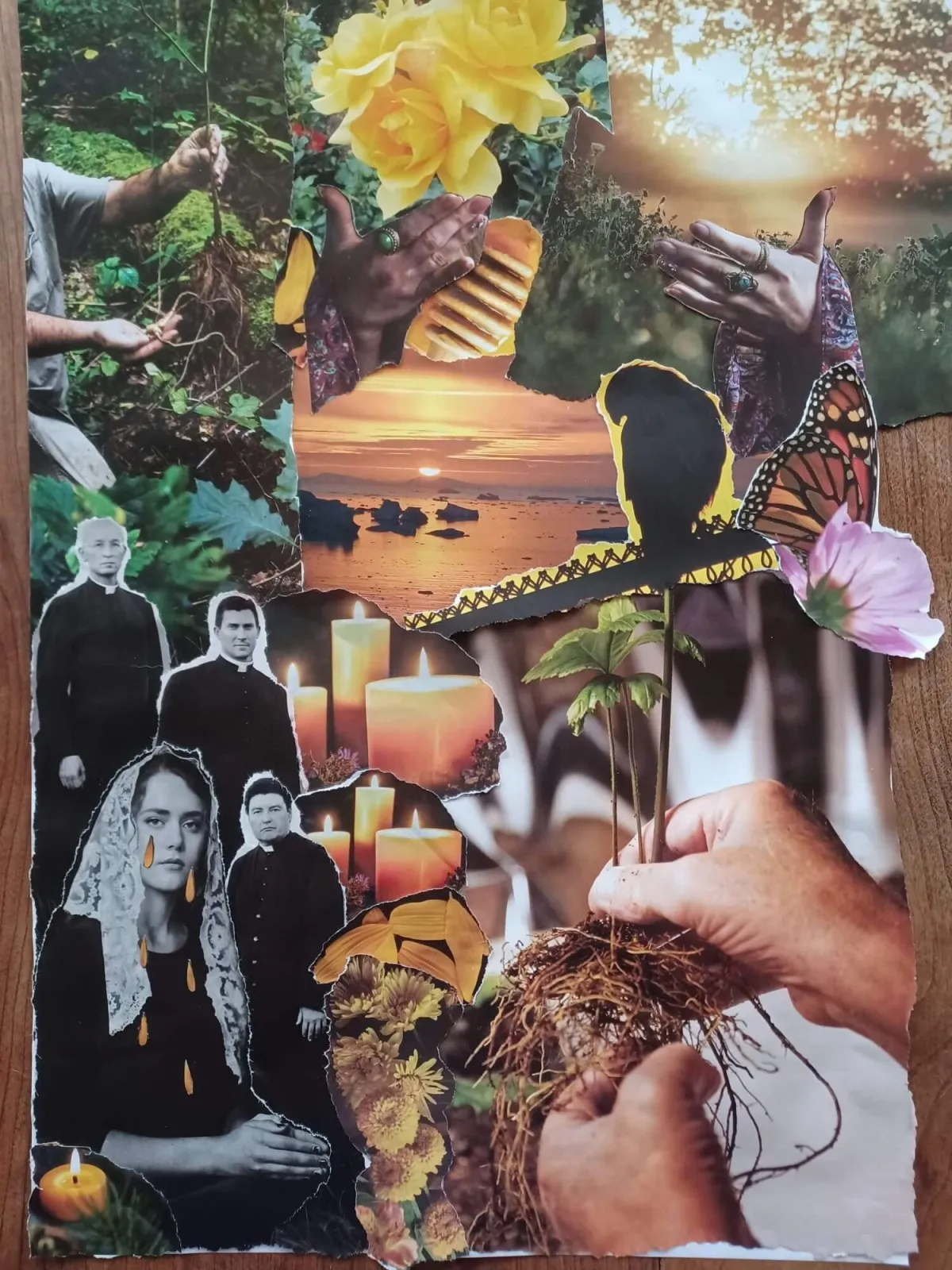
A collage I created in 2023
more insight into it on the FAQ page
I call the Shenandoah Valley home and acknowledge that I am among generations of people who have called this land home. I stand with a deep respect and a sense of sorrow when I think of those who were dispossessed of their lands and these waters, including communities of families that we have come to call Siouan, Monacan, Monahoac, Catawba, and Cherokee.
I acknowledge the safety and security my ancestors were awarded that I continue to benefit from, simply for our lack of melanin which led to easier access to owning land and businesses and therefore higher education. Both the land and the indigenous communities that called these lands home have suffered beyond measure from violence severing that connection and eradicating many of the cultural practices that nourished the hearts and spirits of their people and the land and beings they walked with.
I strive to commit, and re-commit myself to honor both the original inhabitants, this land and this watershed by continuing to learn about and anchor myself in my own blood ancestry and their lands, and by accepting responsibility to stay attuned to where I can effectively show up in my leadership and my service in ways that are appropriate for me as a white woman.
These words are not abstractions, even as my awareness and understanding of them continues to deepen, expand and fortify through lived experiences.
For this, and for those who walked before and in service to those who will walk after me, I bow.
Other acknowledgements:
Sexual Memoir is structured as a BodySoul Writing Workshop which I studied with Marlene Schiwy. Sexual Memoir should not be regarded as a substitute for conventional psychotherapy.
The image of Holy Mother was drawn by Leslie from 'The Faithfully Framed' on Etsy.
